
 by
by As our global skylines reach unprecedented heights, the complexity of protecting the people within them has grown exponentially. In 2026, the conversation is shifting from basic compliance to a proactive era of High-Rise Building Safety Technology. Traditional safety protocols—while foundational—are no longer sufficient to manage the dynamic risks of massive vertical structures. Urban real estate is currently undergoing a “technological rethink,” where artificial intelligence (AI), the Internet of Things (IoT), and advanced material science are merging to create buildings that are not just tall, but intelligent and self-aware.
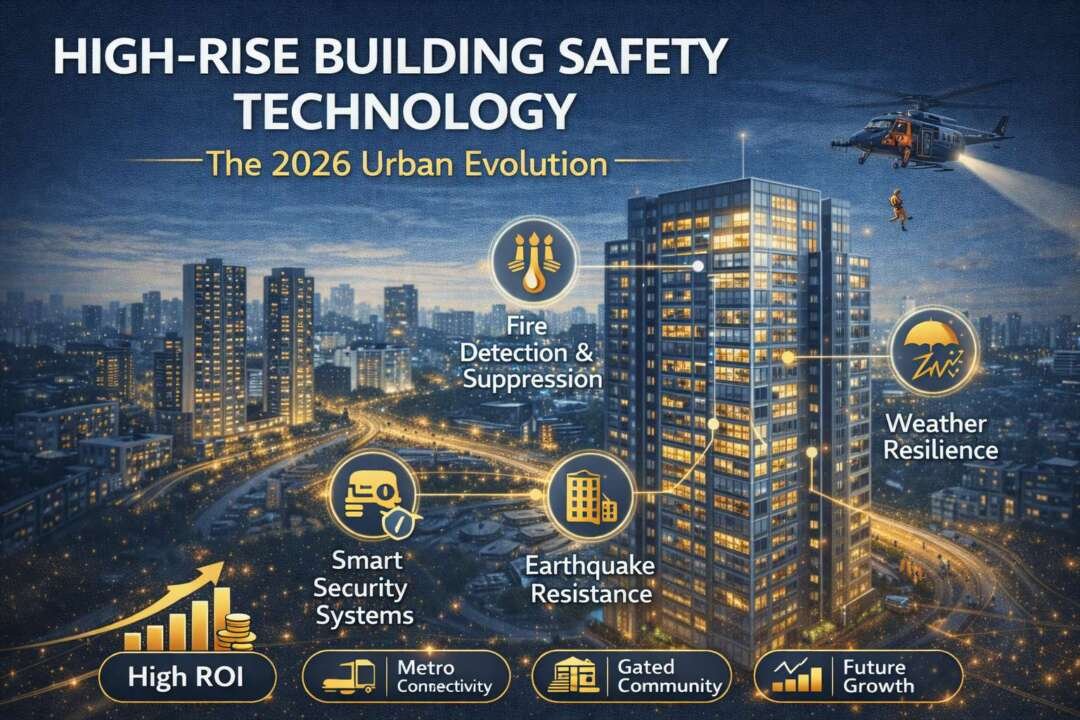
The relevance of High-Rise Building Safety Technology has never been more critical. Recent global urban expansion has placed millions of residents in high-density vertical environments, where fire, structural fatigue, and mechanical failure represent significant challenges. By integrating High-Rise Building Safety Technology, developers are now able to detect a gas leak before a spark occurs, monitor microscopic structural cracks in real-time, and automate evacuations with surgical precision.
This article explores the transformative impact of High-Rise Building Safety Technology on modern urban real estate. We will examine how AI-driven fire detection, IoT-enabled structural monitoring, and smart elevator systems are redefining what it means to live and work safely in the clouds. Ultimately, this analysis demonstrates that the future of the skyscraper is built on a foundation of “Anticipatory Safety,” ensuring that technology works silently in the background to prevent disasters before they manifest.
Understanding High-Rise Building Safety Technology in 2026
The current landscape of High-Rise Building Safety Technology is defined by “The Smart Synergy.” In 2026, we have moved beyond standalone smoke detectors and manual fire pulls. Modern High-Rise Building Safety Technology utilizes a decentralized network of sensors that communicate across a building’s central “digital brain.” This connectivity allows for a holistic view of building health, where environmental data, occupancy patterns, and mechanical status are analyzed simultaneously to identify anomalies.
Why High-Rise Building Safety Technology Matters Today
As vertical density increases, the margin for error in emergency response shrinks. High-Rise Building Safety Technology matters because it provides the gift of time. In a fire scenario, every second counts. Traditional systems might take minutes to confirm a blaze; however, AI-powered High-Rise Building Safety Technology can identify flames and smoke via standard CCTV feeds in less than 0.02 seconds. This rapid identification is essential for preventing small incidents from cascading into catastrophic disasters in high-density urban zones.
The Role of AI in Fire Detection and Prevention
Artificial Intelligence is the vanguard of High-Rise Building Safety Technology in 2026. Computer vision systems now distinguish between a sunset reflection and an actual fire, drastically reducing false alarms. Furthermore, High-Rise Building Safety Technology now incorporates “Ensemble Learning,” where multiple algorithms must agree on a hazard before triggering an alert. This ensures that safety teams only respond to genuine threats, maintaining trust in the system and preventing unnecessary panic.
Structural Health Monitoring (SHM): The Building’s Nervous System
A critical component of High-Rise Building Safety Technology is Structural Health Monitoring (SHM). By embedding fiber-optic sensors and accelerometers directly into the concrete and steel of a skyscraper, engineers can monitor “structural pulse.” This High-Rise Building Safety Technology detects material fatigue, seismic shifts, and wind-induced stress that are invisible to the naked eye. In 2026, SHM is no longer a luxury but a standard requirement for ensuring the longevity and safety of supertall structures.
IoT and Sensor Integration for Real-Time Safety
The Internet of Things (IoT) acts as the connective tissue for High-Rise Building Safety Technology. Wireless sensors distributed throughout a building monitor everything from humidity and temperature to gas concentrations and electrical loads. This High-Rise Building Safety Technology enables “Predictive Maintenance,” where building managers receive alerts about a potentially faulty circuit or a leaking pipe weeks before it causes a failure. This shift from reactive to proactive care is a hallmark of modern urban management.
Smart Elevator Systems and Vertical Safety
Vertical transportation is the lifeline of any skyscraper, making smart elevators a core part of High-Rise Building Safety Technology. In 2026, elevators use AI to predict traffic flow and reduce wait times, but their safety features are even more impressive. Modern High-Rise Building Safety Technology includes flameproof elevator designs with independent IoT monitoring for hazardous gases and mechanical vibrations. If a threat is detected, these elevators automatically enter a safe shutdown mode at the nearest floor to prevent occupants from being trapped during an emergency.
Comparison: Traditional Safety vs. High-Rise Building Safety Technology
| Feature | Traditional Safety Systems | High-Rise Building Safety Tech (2026) |
| Detection Speed | Minutes (Manual/Thermal) | Milliseconds (AI/Computer Vision) |
| Maintenance | Scheduled/Reactive | Predictive/Condition-Based |
| Data Usage | Logged locally, rarely analyzed | Real-time Cloud Analytics & Digital Twins |
| Response | Full-building Alarm | Zoned, AI-orchestrated Evacuation |
| Structural Integrity | Visual Inspection (Annual) | Continuous (Fiber-optic SHM) |
Digital Twins: Virtual Models of Real-World Safety
Digital Twin technology has become a cornerstone of High-Rise Building Safety Technology. A digital twin is a real-time virtual replica of the physical building. By feeding data from IoT sensors into this virtual model, safety officers can simulate “what-if” scenarios, such as the spread of smoke during a fire or the impact of high-speed winds. This High-Rise Building Safety Technology allows for the optimization of evacuation routes and the testing of safety protocols in a risk-free environment.
The Financial Advantage: Why You Should Choose Smart Tech
Investing in High-Rise Building Safety Technology is as much a financial decision as it is a safety one. Buildings equipped with advanced High-Rise Building Safety Technology often benefit from reduced insurance premiums due to their lower risk profile. Additionally, the predictive nature of this technology minimizes downtime and repair costs. For developers, “Safety-as-a-Service” is becoming a premium selling point that increases property value and attracts high-tier corporate and residential tenants.
H2: Market Trends and the Future of High-Rise Building Safety Technology
Looking beyond 2026, the growth of High-Rise Building Safety Technology will likely involve autonomous firefighting robots and drone-based structural inspections. We are already seeing the integration of “Circadian Lighting” and air quality monitoring into the broader definition of safety. As climate change increases the frequency of extreme weather, High-Rise Building Safety Technology will continue to evolve to handle intense heatwaves, flooding, and high-velocity wind events, ensuring urban resilience.
Expert Insights: Rethinking the Human Element
Experts agree that while High-Rise Building Safety Technology is revolutionary, it must work in harmony with human operators. The goal of High-Rise Building Safety Technology is not to replace the safety officer but to augment them with superior data. By filtering out the noise and highlighting only the critical risks, this technology allows human responders to make better-informed decisions during high-stress moments. The “Human-Tech Partnership” is the ultimate evolution of skyscraper safety.
Conclusion
The evolution of High-Rise Building Safety Technology in 2026 marks a turning point in urban architecture. We are no longer building passive structures that wait for disaster to strike; we are creating intelligent, reactive environments that prioritize human life above all else. From the split-second precision of AI fire detection to the constant vigilance of structural health sensors, High-Rise Building Safety Technology has transformed the skyscraper into a safer haven than ever before.
As urban centers continue to expand vertically, the adoption of these technologies is no longer optional—it is a moral and economic imperative. The integration of IoT, AI, and smart vertical transport ensures that our cities can grow taller without compromising on the security of their inhabitants. In the end, the success of modern real estate will be measured not just by the height of its buildings, but by the sophistication of the High-Rise Building Safety Technology that keeps them standing and their occupants protected. The future of urban living is safe, smart, and technologically empowered.
The Commercial and Economic Engine of Knowledge Park 5
The commercial sector in Knowledge Park 5 is poised for explosive growth. The area’s strategic location and well-planned infrastructure have attracted a number of businesses, ranging from IT companies to small-scale enterprises.
- Office Spaces and IT Hubs: The development of purpose-built office spaces and IT parks is a key feature of Knowledge Park 5. Projects like Galactic City are setting new benchmarks for commercial development, offering world-class infrastructure, high-speed connectivity, and modern amenities. These commercial hubs are designed to be self-sufficient, with features like food courts, recreational areas, and ample parking.
- Retail and Mixed-Use Projects: The commercial landscape of Knowledge Park 5 is not limited to offices. The area is also seeing the development of mixed-use projects that combine commercial, retail, and residential spaces. This integrated approach ensures that residents have easy access to shopping centers, dining options, and entertainment venues, creating a truly urban experience within the township. The proximity of residential and commercial areas in Knowledge Park 5 promotes a ‘walk-to-work’ culture, which is highly sought after by today’s professionals.
The economic ecosystem of Knowledge Park 5 is a major draw for businesses seeking to expand their operations in a well-connected and affordable location. The availability of a skilled workforce from the neighboring educational institutions further adds to its appeal. In contrast, buying a Noida studio apartment is a path to creating a tangible asset, building equity, providing a hedge against inflation, and unlocking significant tax benefits. It’s the superior long-term financial strategy for anyone planning to be in Noida for a decade or more, especially if the location is strategic and close to a thriving commercial district like Cyber Arch IT Park. Choose the option that aligns not just with your current salary, but with your five and ten-year personal and financial vision.
FAQs
Q1. What is the most significant benefit of High-Rise Building Safety Technology?
A1. The primary benefit of High-Rise Building Safety Technology is the move from reactive to predictive safety. By using AI and IoT, buildings can detect hazards like fire, gas leaks, or structural fatigue in real-time, often before they are visible to humans. This High-Rise Building Safety Technology saves lives by providing earlier warnings and more precise evacuation data.
Q2. How does AI-driven fire detection in High-Rise Building Safety Technology work?
A2. AI-driven High-Rise Building Safety Technology uses computer vision to analyze live CCTV feeds. Unlike traditional smoke detectors, this system can identify the visual signature of flames and smoke in milliseconds. It also uses ensemble learning to filter out false positives, ensuring that High-Rise Building Safety Technology remains accurate and reliable during emergencies.
Q3. Is High-Rise Building Safety Technology expensive to implement?
A3. While the initial investment in High-Rise Building Safety Technology can be higher than traditional systems, it pays for itself through lower insurance premiums, reduced maintenance costs, and increased property value. Furthermore, modern High-Rise Building Safety Technology can often be retrofitted into existing structures using wireless IoT sensors, making it more accessible.
Q4. What is Structural Health Monitoring (SHM) in the context of building safety?
A4. SHM is a vital part of High-Rise Building Safety Technology that uses embedded sensors to track a building’s physical integrity. These sensors monitor stress, strain, and vibrations continuously. This High-Rise Building Safety Technology allows engineers to see “under the skin” of the building, identifying potential structural issues long before they become dangerous.
Q5. Can High-Rise Building Safety Technology help during a power outage?
A5. Yes. Modern High-Rise Building Safety Technology is often designed with decentralized power and redundant wireless connectivity. Many IoT sensors used in High-Rise Building Safety Technology are low-power and battery-operated, ensuring that safety monitoring remains active even when the primary building grid fails.
Q6. How do smart elevators contribute to High-Rise Building Safety Technology?
A6. Smart elevators are integrated into the building’s High-Rise Building Safety Technology network. They can detect abnormal motor heat or vibrations and shut down safely. In an emergency, these elevators communicate with the building’s AI to assist in zoned evacuations or lock out dangerous floors, making them a critical pillar of High-Rise Building Safety Technology.

Join The Discussion