
 by
by The statement is stark, yet undeniably true for millions: “Buying and selling property in India is ‘traumatic’,” as articulated by the Supreme Court of India. This single, powerful observation cuts through the rosy market forecasts and glossy developer brochures to expose a profound reality. Real estate, which represents the most significant investment for most Indian families, is inextricably linked to anxiety, endless litigation, and systemic vulnerability. This isn’t just about poor customer service; it’s about a foundational crisis of trust rooted in antiquated land records, a confusing array of laws, and a complex bureaucracy that often seems designed to obstruct rather than facilitate.

The process of property buying and selling in India is a high-stakes journey. It involves intricate procedures, from verifying the ‘mother deed’ and checking encumbrances to navigating local municipal laws and managing lengthy registration processes. The emotional and financial toll of a property dispute can be devastating, confirming the court’s assessment of a “traumatic” experience. For a nation that aspires to be a global economic powerhouse, the current system of presumptive titles, where registration is merely a record of a transaction and not a guarantee of ownership, is a significant institutional deficit.
This long-form guide on property buying and selling in India is designed to provide more than just a checklist. We will deconstruct the inherent flaws in the current system, illuminate the crucial judicial mandates intended to simplify transactions, and deliver a comprehensive strategy for buyers, sellers, and investors to navigate this legal maze with intelligence and caution. We will elevate the conversation beyond the transactional—focusing on clarity, legal depth, and practical, risk-mitigating steps—to turn the perceived trauma of property buying and selling in India into a pathway toward secure and confident ownership.
⚖️ Understanding Property Buying and Selling in India: The Systemic Deficiencies
The Supreme Court’s use of the word ‘traumatic’ is not hyperbole; it is a legal critique of India’s current land and title framework. The fundamental issue is the presumptive title system, which contrasts sharply with the ‘conclusive title system’ used in developed economies. In India, a registered sale deed merely provides prima facie evidence of a transaction, not an indefeasible, state-guaranteed title of ownership. This leaves the door permanently open to title disputes, making property buying and selling in India an exercise in constant vigilance.
Why Property Buying and Selling in India is Prone to Trauma
The trauma stems from a convergence of historical, legislative, and administrative failures. Historically, land records were maintained for revenue purposes, not for confirming ownership, leading to a long sustained dichotomy between registration and ownership. Legislatively, we rely on colonial-era laws like the Transfer of Property Act (1882) and the Registration Act (1908), which predate modern digital infrastructure and legal complexities. Administratively, the lack of complete digitization, the presence of multiple conflicting records (revenue, survey, and registration), and the sheer bureaucratic inertia contribute to a system where fraud, forgery, and delays thrive. The difficulty in performing accurate due diligence makes property buying and selling in India inherently risky.
🔑 Key Features and Flaws in the Legal Framework for Property Buying and Selling in India
To truly master property buying and selling in India, one must understand the statutes that govern it, and more importantly, where they fall short. The challenge lies in the gap between what a document says and what it proves.
The Dual Challenge of Registration and Ownership
The Supreme Court has repeatedly clarified that mere registration does not confer ownership. A Sub-Registrar’s job is ministerial—to record the execution of a document—not to adjudicate the seller’s title. This key distinction is misunderstood by most citizens.
- The Registration Act, 1908: This makes registration compulsory for sales above a certain value, but it only records the transaction, assuming the executant has the right to sell.
- The Transfer of Property Act, 1882 (TPA): This defines ‘Sale’ and other modes of transfer. A sale is legally complete only through a registered sale deed. However, the TPA also allows for concepts like ‘Agreement to Sell’ and ‘Part Performance’ (Section 53A), which, while offering limited protection, do not grant full ownership, creating ambiguity and fertile ground for disputes in the realm of property buying and selling in India.
The sheer volume of pending property-related litigation highlights this flaw. If the state guaranteed titles, litigation would plummet, significantly reducing the “trauma” associated with property buying and selling in India.
📈 Future Growth and Development Potential: The Conclusive Title Push
The most significant development potential in the Indian real estate sector does not lie in new construction, but in title reform. Recognizing the trauma in property buying and selling in India, the Supreme Court has strongly advocated for transitioning to a conclusive titling system guaranteed by the State.
The Shift to Conclusive Titling
A conclusive titling system would involve a State guarantee of the accuracy of the land records, making the registered title legally indisputable. This ambitious reform is central to the government’s vision for a robust, transparent real estate market.
- The Draft Model Land Leasing Act and Digital India Land Records Modernisation Programme (DILRMP): These initiatives are foundational. DILRMP aims to digitize and integrate land records (Record of Rights, maps, and registration deeds) into a single-window system.
- Integration of Blockchain Technology: The Supreme Court has explicitly flagged the potential of Blockchain technology for property registration reform. Blockchain creates a secure, transparent, and immutable digital ledger, eliminating the risk of tampering, reducing fraud, and providing a single, verifiable source of truth for ownership history.
This transition, though slow, promises to fundamentally change the experience of property buying and selling in India, transforming it from a high-risk venture into a secure, paperless transaction. This focus on future-proof technology is a crucial step towards de-traumatizing the process.
🛠️ The Buyer’s or Investor’s Perspective: A Guide to Due Diligence
For any party involved in property buying and selling in India, especially the buyer, due diligence is not a step—it is a continuous defense mechanism. Given the system’s flaws, a buyer must become the de facto title insurer.
The Essential 7-Point Due Diligence Checklist for Property Buying and Selling in India
- Check the Chain of Title (Mother Deed): Always trace the ownership history for at least 30 years. Every transaction must be documented via a properly registered instrument. Any missing link or reliance on old, unregistered General Power of Attorney (GPA) agreements is a major red flag.
- Verify Encumbrance Certificates (EC): An EC obtained from the Sub-Registrar’s office reveals if the property has any existing claims, mortgages, or pending legal disputes. An investor in property buying and selling in India must ensure the property is free of all financial or legal liabilities.
- Cross-Check with Revenue Records (Mutation/Khatas): While mutation (updating land revenue records) does not confer title, it is a crucial record of possession for fiscal purposes. Discrepancies between the sale deed and the mutation/Khatas indicate a deep underlying issue.
- Verify Statutory Clearances: For developed properties, check the Commencement Certificate (CC), Occupancy Certificate (OC), and any No-Objection Certificates (NOCs) from relevant authorities (fire, environment, aviation, etc.). Absence of an OC is a significant risk in property buying and selling in India.
- Examine Zoning and Land Use: Confirm that the property’s use (residential, commercial, or agricultural) complies with the Master Plan and local zoning laws. A significant number of property disputes arise from illegal change of land use.
- Physical Possession vs. Paper Title: Ensure the seller is in clear, peaceful physical possession of the property and that boundaries match the documented dimensions. Litigation often arises when there is a mismatch between the paper title and ground reality.
- Public Notice and Local Inquiry: Issue a public notice in local newspapers inviting objections to the transaction. This legally protects the buyer by demonstrating due care and providing an opportunity for hidden claims to surface.
📊 Comparison with Similar Projects or Trends: The Unregulated Market Menace
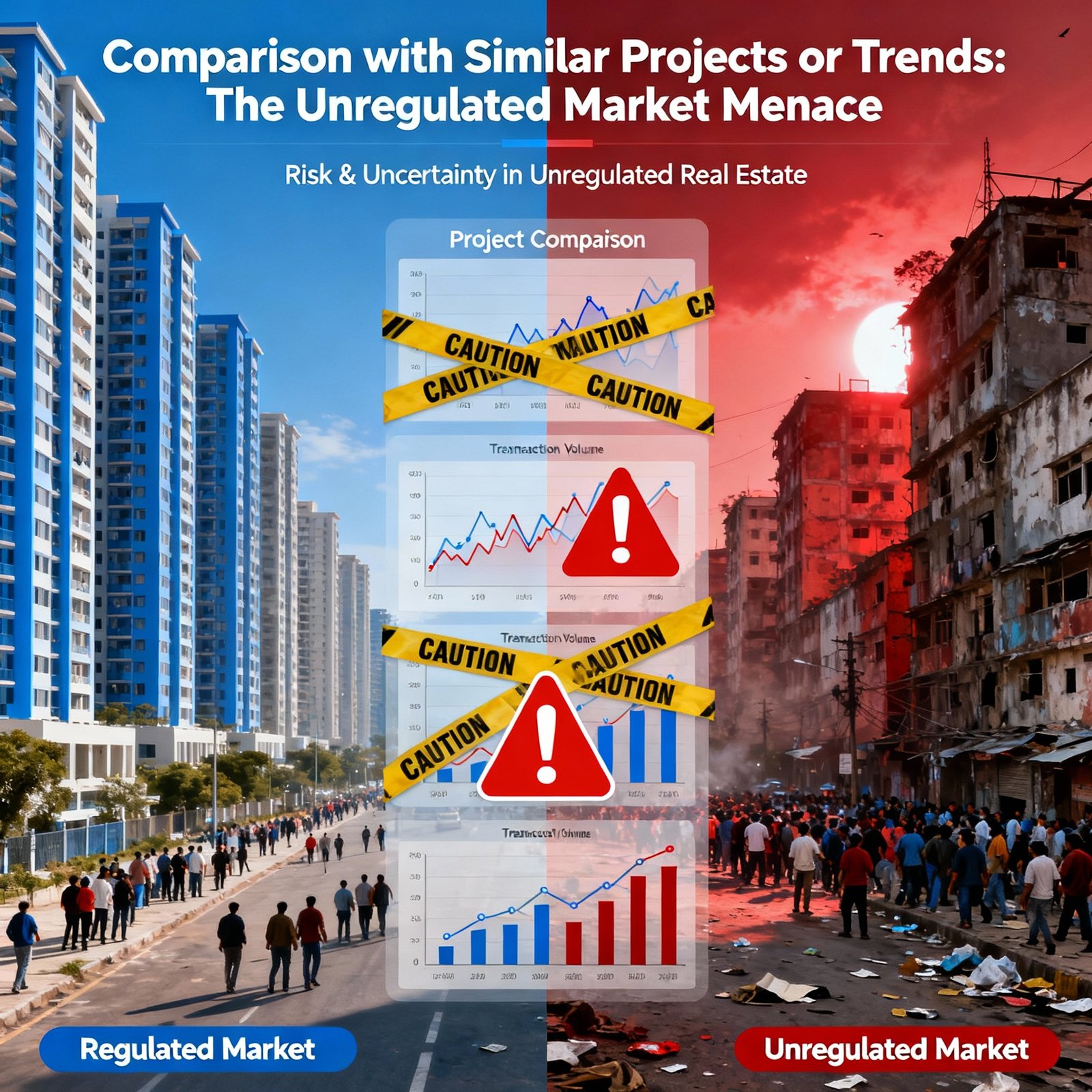
The challenges in property buying and selling in India are amplified by the presence of a vast, often shadowy, unregulated market. This is where the trauma is most acutely felt, particularly in transactions involving agricultural land or ‘unauthorized’ colonies.
RERA vs. The Rest: Two Indias of Property Buying and Selling
The implementation of the Real Estate (Regulation and Development) Act, 2016 (RERA) has created two distinct markets for property buying and selling in India:
| Feature | RERA-Registered Projects | Unregulated/Unregistered Transactions |
| Title Assurance | Higher transparency; requires clear title at registration. Escrow model protects buyer funds. | Low transparency; high risk of defective titles, GPA-based fraud, and multiple sales. |
| Dispute Resolution | Specialized RERA Tribunal for fast-track resolution. Reduced burden on Civil Courts. | Only recourse is the overburdened Civil Court system, leading to years of litigation. |
| Information & Quality | Mandates disclosure of project details, carpet area, and construction timeline. | Information asymmetry; high risk of quality defects, unapproved plans, and illegal construction. |
| Buyer Trauma | Significantly mitigated by regulatory oversight and clear accountability. | Extreme risk, contributing directly to the “traumatic” experience cited by the SC. |
For a long-term, secure investment in property buying and selling in India, prioritizing RERA-compliant properties is non-negotiable, as it shifts accountability from the individual buyer to a statutory regulatory body.
👨💼 Expert Insights and Market Analysis: The Impact of Judicial Activism
Judicial activism has been a powerful force attempting to correct the systemic flaws in property buying and selling in India. The Supreme Court and various High Courts have issued landmark rulings that every stakeholder must understand.
Landmark Judicial Mandates in Property Buying and Selling in India
- The Invalidity of Sale on GPA: The SC has repeatedly held that a sale deed executed based only on a General Power of Attorney (GPA) does not confer ownership. This ruling was critical in curbing the massive fraud prevalent in urban and semi-urban areas where the seller tried to bypass stamp duty and registration.
- Strict Timelines for Registration: The SC has reinforced the strict deadlines under the Registration Act, 1908, stating that a document must be presented for registration within four months of execution, with a maximum permissible delay of another four months upon payment of a fine. Late registration is a severe red flag in property buying and selling in India, often deemed fraudulent.
- Title Adjudication by Civil Courts Only: The court has clarified that Sub-Registrars do not have the adjudicatory power to decide on the seller’s title. Any dispute over ownership must be resolved by a Civil Court, reinforcing the separation of administrative function (registration) from judicial function (title verification).
These judicial pronouncements are the legal system’s attempt to provide clarity and curb the “trauma.” An informed investor in property buying and selling in India must rely on these mandates, rather than local customs or informal agreements.
🛡️ Why You Should Choose Legal Clarity in Property Buying and Selling in India
The decision to buy or sell property is a choice between a secure future and a litigation nightmare. Choosing legal clarity means prioritizing the foundational robustness of the transaction over perceived cost savings or speed. This is the ultimate de-traumatizing strategy for property buying and selling in India.
Mitigating Risk in Property Buying and Selling in India
- Insist on the Registered Sale Deed: Never settle for an Agreement to Sell, Will, or GPA as proof of final transfer. The only instrument that legally conveys title is a Registered Sale Deed.
- Don’t Ignore Mutation: While not title proof, updated mutation records are essential for collecting revenue, utility connections, and preventing future land revenue disputes. A clean property buying and selling in India transaction ensures the buyer’s name is recorded in all relevant state records.
- Use Title Insurance (Emerging Market): Although still nascent, title insurance is beginning to appear in the Indian market. It offers financial indemnity against losses arising from defects in title—a direct countermeasure to the risks inherent in the presumptive title system of property buying and selling in India.
By adhering to the strictest interpretation of the law, stakeholders can create their own bubble of certainty within the larger, traumatic market of property buying and selling in India.
🔮 Pricing and Investment Insights: The Value of a Clear Title
In the Indian real estate market, the clearance of title is the most significant determinant of a property’s true value, far surpassing construction quality or location.
Title Premium vs. Market Discount
A property with a guaranteed, undisputed, and complete chain of title (e.g., in a RERA-registered, OC-compliant project) commands a “Title Premium”—it will sell faster and at a higher rate because the risk of future litigation is minimized.
Conversely, properties with flawed titles, inherited through decades-old unregistered documents, or entangled in local disputes trade at a significant “Market Discount.” While these look like ‘bargains,’ the discount represents the highly concentrated risk of future legal trauma. Astute investors realize that a clear title is an asset, and a dispute is a liability. The true cost of property buying and selling in India must factor in potential legal expenses.
Navigating Inherited and Joint Properties
One of the most complex segments of property buying and selling in India involves inherited or joint family property. The Hindu Succession Act (HSA) and personal laws create intricate ownership webs. Investors must insist on:
- Registered Will or Succession Certificate: For inherited property, the primary document must be a duly executed and registered Will, or a Succession Certificate/Letter of Administration from a court.
- No Objection Certificates (NOCs) from All Legal Heirs: In cases of ancestral or joint family property, every single legal heir must be party to the sale deed to extinguish their claim permanently. A fractional, disputed title is a direct path to trauma in property buying and selling in India.
🤝 Why Local Expertise is Non-Negotiable for Property Buying and Selling in India
Given the local nature of land records, tax systems, and municipal bye-laws, an individual’s attempt to navigate property buying and selling in India without expert help is a key contributor to the trauma.
The Role of the Legal Specialist
A skilled property lawyer does more than draft a sale deed; they perform the essential risk assessment that the state system fails to provide.
- Title Search & Opinion: They conduct a methodical search of records in the Sub-Registrar’s office, revenue office, and local bodies to issue a formal Title Opinion—a written, expert legal guarantee (or warning) on the title’s marketability.
- Litigation Check: They scour court records for any pending suits related to the specific property or parties involved. An ounce of prevention here saves decades of litigation heartache, which is the very definition of the ‘trauma’ in property buying and selling in India.
The investment in expert legal counsel is an insurance policy that significantly reduces the odds of the transaction becoming one of the many property disputes clogging the Indian judicial system.
🎯 Conclusion — The Final Word on Property Buying and Selling in India
The Supreme Court’s blunt assessment that property buying and selling in India is “traumatic” serves not as a deterrent, but as a critical call to action. It is a judicial acknowledgment of the systemic flaws that subject citizens to unnecessary risk, financial loss, and emotional distress. The pathology of the system lies in the fact that registration does not equate to ownership, forcing citizens to become their own de facto title guarantors.
The solution to de-traumatizing the process of property buying and selling in India is dual-pronged: institutional reform and individual prudence. Institutional reforms, driven by judicial mandates, are pushing for conclusive titling and the integration of tamper-proof technologies like Blockchain. However, until this system is fully realized, individual success hinges entirely on meticulous, enhanced due diligence.
For every buyer, seller, or investor, the lesson is clear: legal clarity is the most valuable feature of any property. Insist on a registered sale deed, verify the 30-year chain of title, demand RERA compliance, and secure expert legal counsel. By elevating your standards and adopting a Skyscraper-level of due diligence that goes beyond the basic checklist, you can navigate the complexities of property buying and selling in India and confidently secure your investment, transforming the trauma into triumph.


Join The Discussion