
 by
by If you’ve been tracking the rapid evolution of the National Capital Region (NCR), you know that the “center of gravity” is shifting. While Delhi remains the historic heart, the pulse of future urban living has moved eastward. Specifically, Sector 4 Greater Noida (often referred to as part of Noida Extension or Greater Noida West) has emerged as one of the most talked-about micro-markets in the country.
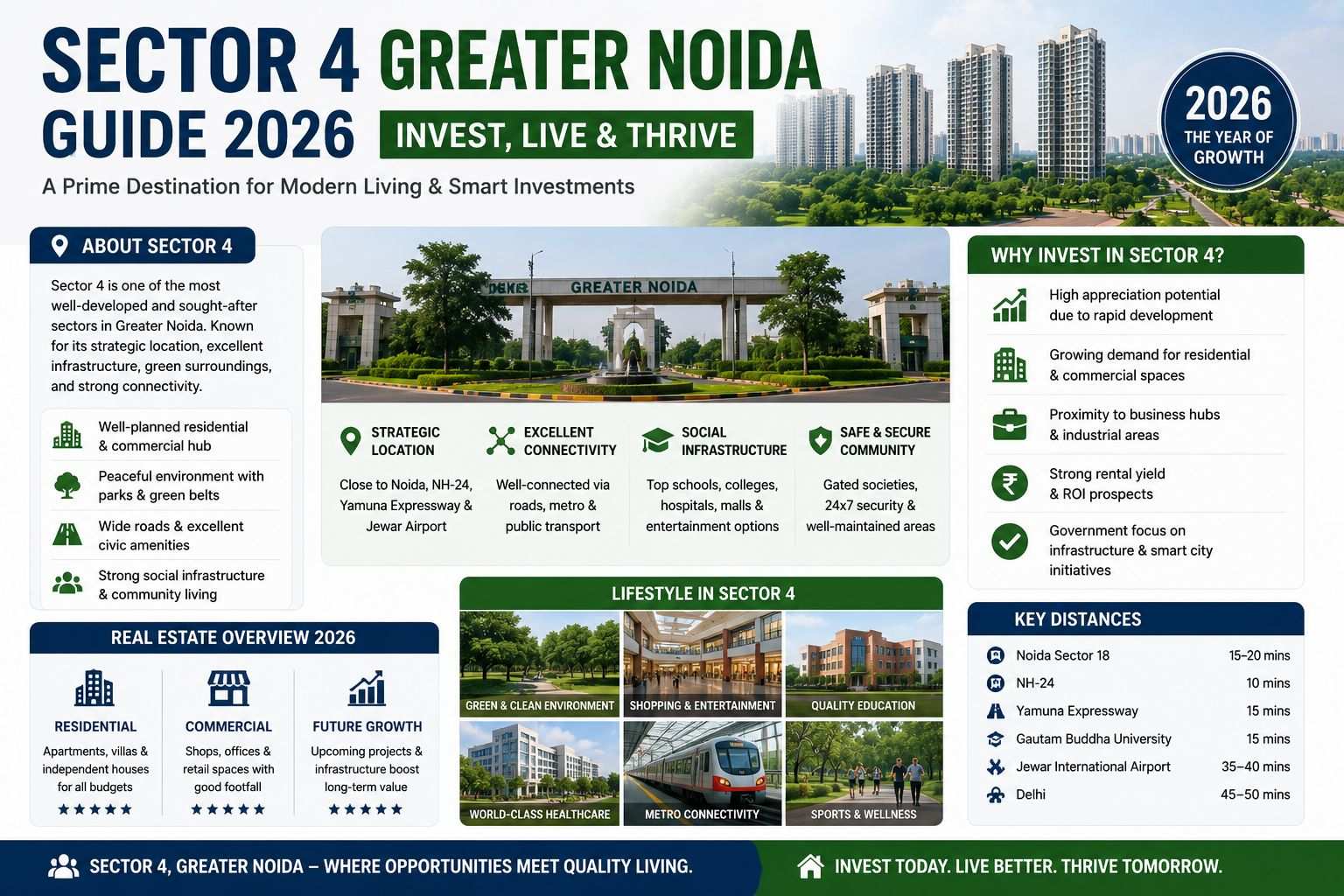
But why now? In 2026, we aren’t just looking for “four walls and a roof.” We are looking for connectivity that doesn’t involve three-hour commutes, infrastructure that supports high-speed digital lifestyles, and green spaces that offer a breather from the concrete jungle. Sector 4 Greater Noida hits that “sweet spot” where affordability meets aspiration. Whether you are a first-time homebuyer tired of soaring Delhi rents or an investor looking for the next capital appreciation goldmine, this sector demands your attention. In this comprehensive guide, we’ll peel back the layers of this locality to see if it truly lives up to the hype.
What is Sector 4 Greater Noida?
Simple Explanation
At its core, Sector 4 Greater Noida is a strategically planned residential and commercial hub located in the area popularly known as Greater Noida West. It serves as a gateway between the established sectors of Noida and the expansive industrial zones of Greater Noida. It is characterized by high-rise residential complexes, wide boulevards, and a rapidly filling commercial landscape that caters to thousands of young professionals and families.
Why It Matters in 2026+
As we move further into 2026, the completion of key infrastructure projects—like the Aqua Line Metro extension and the operational stabilization of the Noida International Airport (Jewar)—has turned Sector 4 from a “future promise” into a “present reality.” It no longer feels like a construction site; it feels like a neighborhood. The maturity of the social fabric here makes it a blueprint for modern Indian urban planning.
Key Features / Highlights
Smart Infrastructure
Unlike the older, more congested parts of the NCR, Sector 4 was designed with a “grid-iron” layout. This means wider roads (minimum 12 to 24 meters internally), underground cabling for electricity, and dedicated sewage treatment plants. In 2026, the integration of smart street lighting and traffic management systems has significantly reduced the “chaos factor” typically associated with growing Indian suburbs.
The “Green” Buffer
One of the standout features of Sector 4 is its proximity to the Hindon River and the massive green belts surrounding it. The planners have ensured that a significant percentage of the land remains open. This results in a “heat island” effect that is slightly lower than the dense clusters of Central Noida or Ghaziabad.
Educational and Medical Hub
The sector is surrounded by what experts call a “Knowledge Ecosystem.” Within a 5-10 km radius, you have access to some of the finest schools (like Gagan Public School and Sarvottam International) and multi-specialty hospitals (like Yatharth and Sarvodaya). For a family, this means the essentials are never more than a 15-minute drive away.
Benefits of Sector 4 Greater Noida
Financial Benefits
The primary driver for Sector 4 has always been the Value Proposition. While property prices in South Delhi or Gurugram have hit a ceiling, Sector 4 still offers entry-level pricing for luxury-grade amenities. You can often find a 3BHK here for the price of a 1BHK in a premium Delhi neighborhood.
Lifestyle / Business Benefits
For the modern remote or hybrid worker, the residential complexes in Sector 4 are a dream. Most projects come equipped with high-speed fiber-optic readiness, massive clubhouses, and co-working spaces within the society gates. It’s a “work-play-live” environment that prioritizes convenience.
Long-Term Value
With the proposed expansion of the Metro and the upcoming multimodal transport hubs nearby, the land value in Sector 4 is projected to see a steady 8–12% year-on-year growth. It is an “appreciating asset” in every sense of the word.
Location / Market Analysis
Connectivity
Sector 4 is a connectivity powerhouse. It sits comfortably near the FNG (Faridabad-Noida-Ghaziabad) Expressway, which is a lifeline for commuters. Furthermore, the DND Flyway provides a straight shot into Delhi, and the Noida-Greater Noida Expressway links it to the industrial heart of the region.
Infrastructure Growth
The most significant update for 2026 is the progress on the Aqua Line Metro Extension. The dedicated station for Sector 4 is a game-changer, slashing travel times to the Noida City Centre and Sector 51. Additionally, the improved road network has made the commute to the Pari Chowk area much smoother.
Future Potential
The “Jewar Effect” is real. As the Noida International Airport scales up operations, Sector 4 becomes a prime residential choice for airline staff, logistics professionals, and frequent flyers who want to stay away from the airport noise but close enough for a 45-minute drive.
Investment Potential / Use Case
ROI Opportunities
Investors in Sector 4 are currently seeing two types of returns:
- Capital Gains: Buying under-construction units and selling upon completion.
- Rental Yields: There is a massive demand from young IT professionals working in the nearby Techzones. Rental yields in this sector are currently hovering around 3.5–4.5%, which is higher than the national average for residential property.
Risk Factors (Be Honest)
No investment is without risk. In Sector 4, the primary concerns are:
- Water Quality: Like much of the NCR, groundwater can be hard, necessitating high-quality RO systems.
- Traffic Bottlenecks: While the internal roads are great, the entry points during peak hours (near Gaur Chowk) can still be a headache.
- Possession Delays: While most big-name builders have delivered, some smaller projects still lag.
Who Should Invest?
- End-Users: Young families looking for a modern lifestyle on a budget.
- First-Time Investors: Those looking for a stable asset with low entry costs.
- Corporate Landlords: Looking to build a portfolio of rental properties for the booming IT workforce.
Comparison Section
Sector 4 vs. Central Noida (Sectors 75-78)
Central Noida is more “established” but also much more expensive and crowded. Sector 4 offers newer inventory, better-planned ventilation, and significantly lower price points for the same square footage.
Why It Stands Out
Compared to other parts of Greater Noida West, Sector 4 has a better “mix” of ready-to-move-in projects and upcoming commercial hubs. It doesn’t feel like an isolated island; it feels like part of a continuous urban stretch.
Step-by-Step Guide to Buying in Sector 4
Step 1: Define Your Budget and Needs
Are you looking for a 2BHK for a small family or a 4BHK with a servant room? Prices in 2026 range from ₹75 Lakhs to ₹2.5 Crores depending on the luxury quotient.
Step 2: Verification and Due Diligence
Always check the UP-RERA website. Ensure the project is registered and the builder has a clean track record for delivery. In Sector 4, look for names like Gaur, ATS, or Galaxy which have a strong presence.
Step 3: Site Visits at Different Times
Visit the sector on a weekday evening to check traffic and on a weekend to see the “vibe” of the local markets. Check for the proximity of the nearest grocery stores and pharmacies.
Expert Tips (Human Touch Section)
- Check the Facing: In the NCR heat, North-East facing apartments are highly coveted as they stay cooler and get the morning sun.
- Rental Demand is King: If you’re investing, pick a project closest to the proposed Metro station. The “last mile” connectivity adds a premium to your rent.
- Don’t Ignore the “Maintenance”: Talk to current residents about the society’s upkeep. A beautiful building with a poorly managed STP or lift system is a nightmare.
- Look for “Mixed-Use” Proximity: Living near a commercial complex like Gaur City Mall or the upcoming Sector 4 high-streets adds a massive convenience factor.
- Verify the “Super Area” vs. “Carpet Area”: This is where most buyers get confused. Always ask for the actual usable square footage inside the walls.
Common Mistakes to Avoid
- Buying Solely on Price: A “cheap” project often has hidden costs in the form of poor construction quality or lack of security.
- Ignoring the Master Plan: Don’t just look at the building; look at what’s planned for the empty plot next door. You don’t want a “park view” turning into a “mall wall” in two years.
- Delaying the Move: As the Metro nears full operation, prices are expected to jump. Waiting for the “perfect time” might price you out of the market.
Future Trends (2026–2030)
By 2030, Sector 4 Greater Noida is expected to be a fully mature micro-market. We predict a heavy shift toward “Green Buildings” and EV-ready parking spots as standard features. The commercial landscape will likely evolve from basic grocery shops to high-end retail and fine-dining “high streets,” making the sector a self-sustaining ecosystem where residents rarely need to leave the area for leisure.
Conclusion
Sector 4 Greater Noida isn’t just another coordinate on a map; it represents the evolution of the Indian middle class’s housing aspirations. It offers a rare combination of strategic location, modern infrastructure, and genuine value for money. While there are growing pains—as with any rapidly developing area—the trajectory is clearly upward. If you are looking for a place that balances the hustle of the NCR with the comforts of a planned township, Sector 4 is arguably your best bet in 2026.


Join The Discussion